
More useful computation per transistor, per cycle, per mm² and per joule.
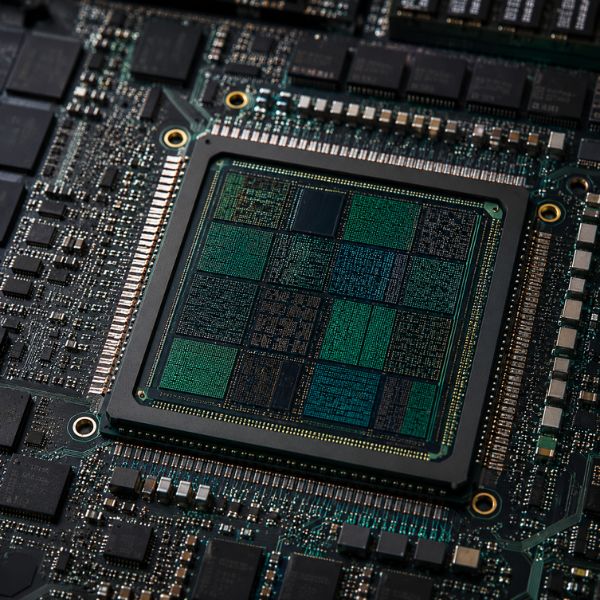
DRDCL, Dynamically Reconfigurable Differential Cascode Logic, is a CMOS-compatible digital logic structure designed to increase useful computation per transistor, per cycle, per mm² and per joule. DRDCL combines differential cascode trees with dynamic Cross-Switch output control. One evaluated structure can support multiple related functions, produce multiple useful outputs and rapidly reconfigure for different required operations. SoftChip packages these structures as bounded, characterizable logic blocks for integration into conventional semiconductor design flows. Soft-NMC, near-memory reduction for AI inference, is the first commercial application.
The combination of common evaluation, multiple useful outputs, lower intermediate switching and nanosecond-scale reconfiguration allows DRDCL to perform more required work within a smaller logic and energy budget.
SoftChip’s initial deliverables are bounded DRDCL logic blocks designed to be evaluated, characterized, benchmarked and integrated into existing semiconductor design flows.
DRDCL is particularly valuable where related functions, repeated evaluations, multiple required outputs or excessive staging create a high transistor, switching, latency or area cost.
These functions appear across AI inference, memory-interface logic, networking, DPUs, baseband processing, sensor fusion, ADAS, adaptive compute, and control/dataflow systems.
SoftChip’s first implementation focus is Stream / Reduce / Accumulate logic for workloads that repeatedly score, select, reduce, accumulate, gate or update local state as data moves through a system. This provides a bounded starting point for demonstrating DRDCL’s ability to perform more useful work per evaluation while reducing intermediate movement and staging.
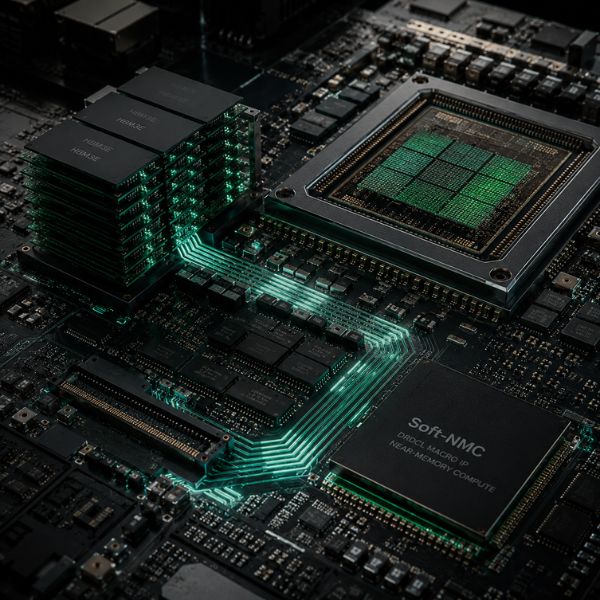
AI inference is increasingly constrained by K/V traffic movement during decode, not peak compute.
As context windows grow, attention repeatedly revisits prior K/V entries through the memory interface and compute fabric.
Soft-NMC applies DRDCL near the memory interface to reduce K/V-derived traffic before it travels deeper into the accelerator.
Soft-NMC is designed to:
Candidate functions include scoring, selection, reduction, accumulation, masking, gating, local maximum tracking, normalization assistance and controller-side dataflow logic.
Soft-NMC can be placed near the memory-channel interface without changing the DRAM cell or the mathematical result of attention.
Soft-NMC does not change what attention computes. It changes where selected reduction happens.
Historical differential cascode logic demonstrated approximately 2x higher speed and approximately half the dynamic power of conventional CMOS in prior comparisons. For suitable functions, producing five useful outputs from one evaluation, combined with the historical circuit-speed advantage, can provide approximately 10x effective local throughput.
Structural estimates for equivalent sets of related functions indicate substantially higher logic density as tree depth increases:
IN-LOGIC STATE RETENTION Selected DRDCL trees may retain intermediate results locally, potentially reducing the number of conventional latches required for short-lived state and helping make precharge transparent to surrounding computation.
SoftChip works with semiconductor, AI hardware, and foundry ecosystem partners to evaluate where DRDCL can outperform equivalent CMOS logic. Initial engagements focus on bounded DRDCL logic blocks with clear PPA targets, defined interfaces, integration assumptions, and measurable benchmark criteria. The goal is to evaluate DRDCL in a practical implementation context, without requiring a wholesale change to existing design flows.
Target logic where repeated evaluation, intermediate movement, or duplicated CMOS structures create a measurable PPA penalty.
Establish equivalent functionality, timing target, area, power, and integration assumptions.
Implement the selected function as a characterizable, interface-defined block rather than a broad change to the design flow.
Measure the DRDCL implementation against the CMOS baseline across relevant operating conditions.
Compare not only gate count or frequency, but the amount of useful computation completed per cycle, per mm², and per joule.
Package the result for customer evaluation, NRE expansion, function customization, or IP licensing.
A focused comparison of one high-value function against a conventional CMOS implementation.
A structured engagement to implement, characterize, and benchmark a DRDCL logic block for a customer-relevant use case.
Translation of selected reduction, control, arithmetic, or memory-adjacent functions into DRDCL structures.
Assessment of DRDCL-based logic near the memory boundary to reduce movement before traffic crosses the fabric.
Timing, power, area, and PVT characterization designed to support practical integration review.
Commercial licensing of validated DRDCL logic blocks for customer-specific silicon programs.
SoftChip is working with semiconductor, AI hardware, memory and foundry ecosystem partners on bounded logic-block evaluations with defined technical benchmarks, integration assumptions and commercial milestones.